
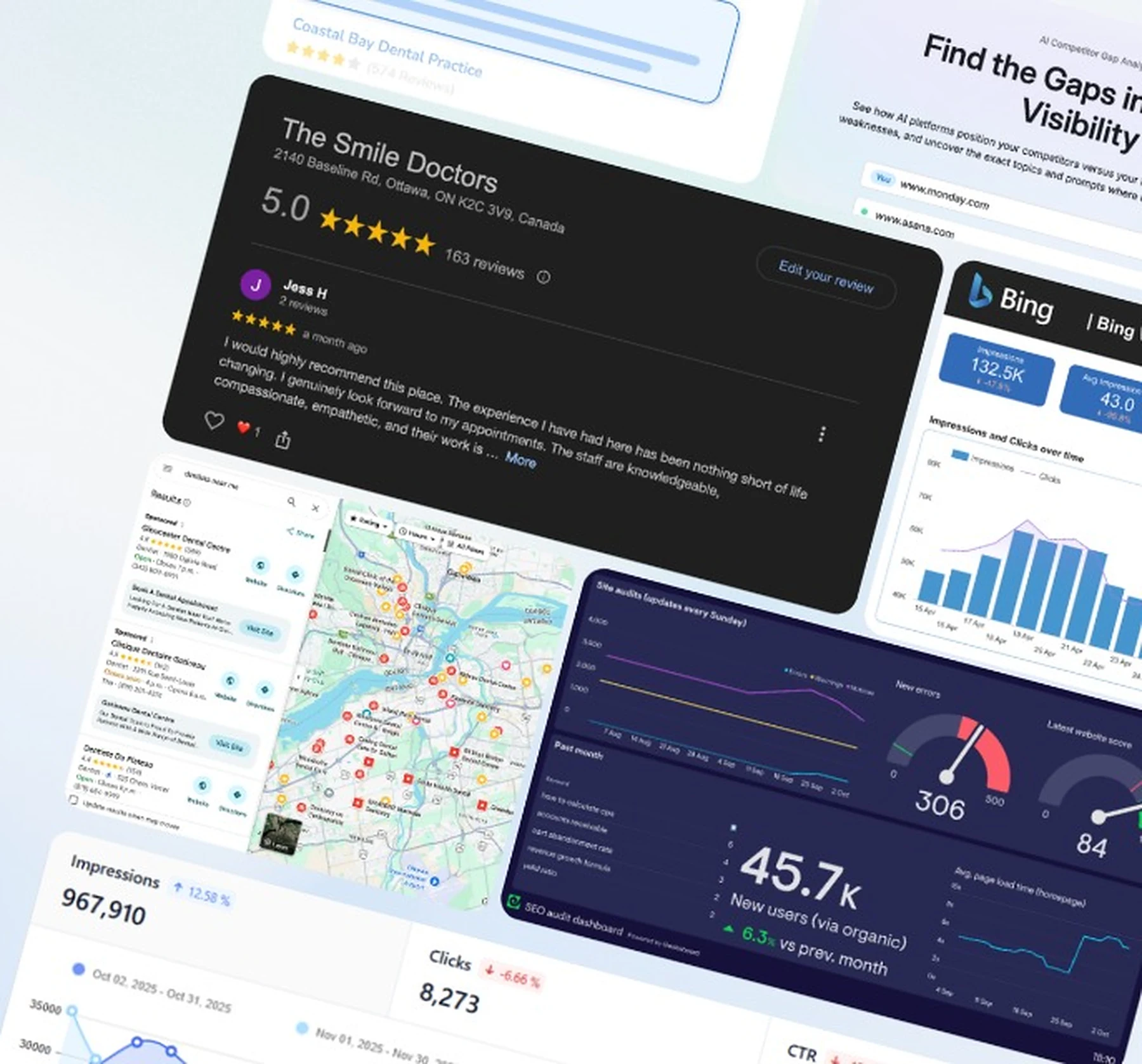
Local SEO, GEO & Google Maps for dental practices
Show up in classic search, Maps, and the answers patients get from AI tools, with facts that match everywhere.
What is local SEO for dental practices?
Local SEO for dental practices is the work of making your clinic easy to find, understand and choose when patients search nearby: in Google Search, Google Maps and AI answers. It covers your Google Business Profile, service pages, reviews and consistent clinic details across the web.

Key takeaways
Where patients find dental clinics today
Most new patients still start with Google, Search, Maps, and increasingly AI summaries that pull from your profile and site. We align your Google Business Profile, on-site service pages, and factual consistency so humans and automated systems describe your practice the same way. Work is paced for your market: dense cities need different tactics than suburban or regional draws.
Example searches we plan visibility around
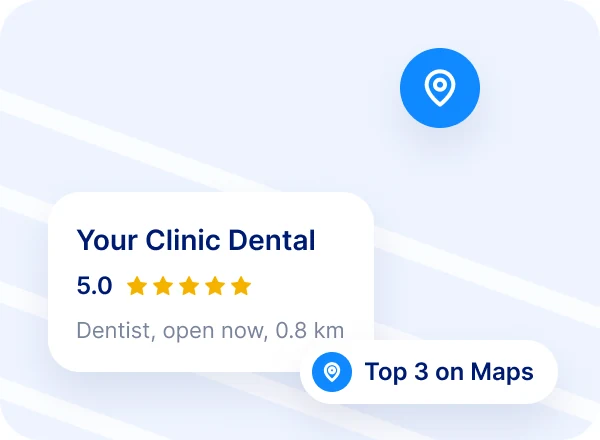
What is local SEO?
Local SEO (search engine optimization) is the work of helping your practice show up when people search in your area, for example "dentist near me," "emergency dentist," or "Invisalign [city]." It combines your Google Business Profile (GBP, the Maps listing), your website, reviews, and citations so Google understands who you are, where you are, and what you treat. GEO, generative engine optimization, is the newer sibling: it is about being described accurately when patients get answers from AI overviews and assistants, not only blue links. Both depend on the same foundation: consistent facts and clear service language.
Why does local SEO matter for dental practices?
Search, Maps, and AI summaries all pull from the same footprint, here is why nailing local discovery pays off.
Patients decide in seconds
High-intent patients compare you in seconds on Maps and mobile search; if categories, photos, or hours are wrong, they call someone else.
Specialty growth needs matching pages
Specialty and fee-for-service growth (implants, ortho, sleep, perio surgery) needs pages and entities that match how people actually search, not only how clinicians label procedures.
AI summaries need consistent facts
AI summaries and Maps pull from GBP and your site; when those disagree, patients lose trust before they ever reach your front desk.
Multi-location logic matters
Multi-location groups live or die on whether each location has correct landing pages and GBP logic, otherwise locations compete with each other.
Reviews drive choice and ranking
Reviews and recency signals influence both human choice and local ranking; ignoring reputation is effectively choosing invisibility.
Single-location and multi-site general, family, cosmetic, orthodontic, and specialty practices competing in Canadian markets, from tight urban corridors to wider service areas.
What do you need to get started?
Practical items so the program launches cleanly, nothing here is about selling extras you do not need.
What is included in local SEO?
Concrete outputs you can expect from an engagement shaped around your market.
How does local SEO work with Dentech?
Three beats: discovery, build, and iteration, so expectations stay clear.
Discover
We align on markets, services, and what "winning" means in your ZIP or city set, including how you should appear in AI summaries.
Build baseline
Technical and local footprint review; GBP, site, and entity consistency sequenced for impact in Search and generative surfaces.
Publish & iterate
Localized, trustworthy content; measurement; and monthly tuning based on queries, leads, and evolving search/AI behavior.
How local SEO and GEO work in plain language
Technical detail in plain language, so you know what we are doing and why it matters for patients and platforms.
Google Business Profile (GBP) and Maps
GBP is the structured record Google uses for Maps, local pack results, and many knowledge-style answers. Primary and secondary categories, services with descriptions, attributes (e.g. accessibility), photos, and Q&A all send signals about relevance. We align categories with how patients search, not only how software defaults suggest.
Photo cadence and quality affect engagement; we give practical capture briefs so your team or photographer can feed the profile without clutter.
On-site structure, entities, and internal links
Search engines and AI systems both benefit when each major procedure has a dedicated page with plain-language headings, FAQs, and internal links to related services and providers. Thin "doorway" pages hurt; specific, helpful pages help.
Internal linking distributes authority and clarifies relationships, for example linking "dental implants" to "bone grafting" and "sedation dentistry" where appropriate.
NAP, citations, and schema (where it helps)
NAP stands for name, address, and phone, your core identity online. Inconsistent NAP across directories confuses Google and patients. We audit high-impact listings and fix conflicts without chasing every obsolete directory.
Structured data (JSON-LD schema) can clarify organization, local business, and FAQs when implemented correctly; we recommend it where it reflects visible content, not as a gimmick.
GEO in plain terms
Generative systems summarize from multiple sources. When your GBP, site, and bios agree on doctors, hours, insurance posture, and flagship services, summaries are more likely to be accurate. GEO is not "tricking AI", it is disciplined factual marketing plus strong pages worth citing.
What results can you expect?
Plain-language signals we work toward, your market and capacity shape how quickly each shows up.
Which local SEO mistakes should clinics avoid?
Patterns we see across dental markets, so you can sidestep them early.
Keyword-stuffed city pages that read fake and get ignored by both users and algorithms.
Ignoring the difference between brand search and non-brand local search, both need different content and measurement.
Letting a marketing vendor "own" GBP under their email; you should retain ownership.
Chasing blog volume instead of answering the twenty questions patients in your market actually ask.
Treating reviews as "someone else's job" instead of a steady, ethical request process tied to real visits.
How do we measure local SEO results?
Leading and lagging indicators agreed upfront, so progress is visible without hype.
Non-brand impressions and clicks in Search Console for priority local queries.
GBP actions: calls, direction requests, website taps, trended month over month.
Rank distribution for tracked terms (e.g. top 3 / top 10) for each priority service and location.
Review velocity, rating stability, and qualitative themes in feedback.
Landing page engagement on key service URLs (scroll, time on page where meaningful).
Reporting your team can act on, not a spreadsheet nobody opens.
Local SEO questions from dental owners
Questions we hear from owners who care about rankings but also about wrong addresses in AI summaries.
How is the local map pack different from the organic listings below it?
The map pack is the block of three clinics with a map that Google shows for local searches. It ranks mainly on your Google Business Profile: categories, distance, reviews and how complete and active your profile is. The organic listings below it rank web pages, so they depend more on your service pages, site structure and links. Most clinics need both: a strong profile for the map pack and clear service pages for organic results.
Should every associate get their own Google Business Profile?
Usually no. Google allows individual practitioner profiles, but for most clinics one strong practice profile works better and avoids splitting reviews and calls. We look at it case by case: a specialist who sees patients under their own name may need a separate profile, set up so it supports the main clinic listing.
A competitor's listing looks fake or keyword-stuffed, what is the first step?
Collect evidence first: screenshots of the listing, the real business name on their signage and website, and the address. Then use "Suggest an edit" on the listing, and for clear spam Google's Business Redressal Complaint Form. We document each step so you can follow up if Google does not act the first time. Improving your own profile usually moves you more than fixing a competitor.
How long until GBP or rankings feel different?
Profile fixes like categories, services, hours and photos can change how you appear within a few weeks. Rankings for competitive treatments in larger cities usually build over three to six months, depending on reviews, content and competition. Our monthly readout shows which signals are moving before rankings fully catch up.
Can one dentist work at two addresses without confusing Google?
Yes. The dentist appears on each clinic's website and profile as a provider at that location, with clear days for each address. What confuses Google is creating two personal profiles for the same person or using different names and phone numbers. We keep the facts consistent across both clinics' pages and listings.
How do you handle English and French searches in the same city?
We plan both languages as real content, not automatic translation: English and French versions of key service pages with proper language tags, a Google Business Profile that describes services the way each audience searches, and reviews and posts in both languages where it makes sense. This matters most in bilingual markets like Ottawa and Gatineau.
Do we need a separate landing page for every suburb we want?
Not for every suburb. Pages that only swap the city name read as thin content and rarely rank. We create location pages where you have a real presence or a clear reason to serve that area, with specific details like directions, team and services offered there. For nearby areas, strong service pages and a well-set service area in your profile usually work better.
Can AI tools like ChatGPT recommend our clinic to patients?
Yes. ChatGPT, Google AI Overviews and Perplexity already suggest clinics when patients ask for a dentist nearby. They pull from your Google Business Profile, website, reviews and directory listings. When those sources show the same facts and your service pages answer real patient questions, AI tools are more likely to describe your clinic accurately and mention it.
Ready to talk specifics?
Tell us about your market, services and goals. We will map a practical next step.